
Donec efficitur, ligula ut lacinia
viverra, lorem lacus.
Donec efficitur, ligula ut lacinia
viverra, lorem lacus.
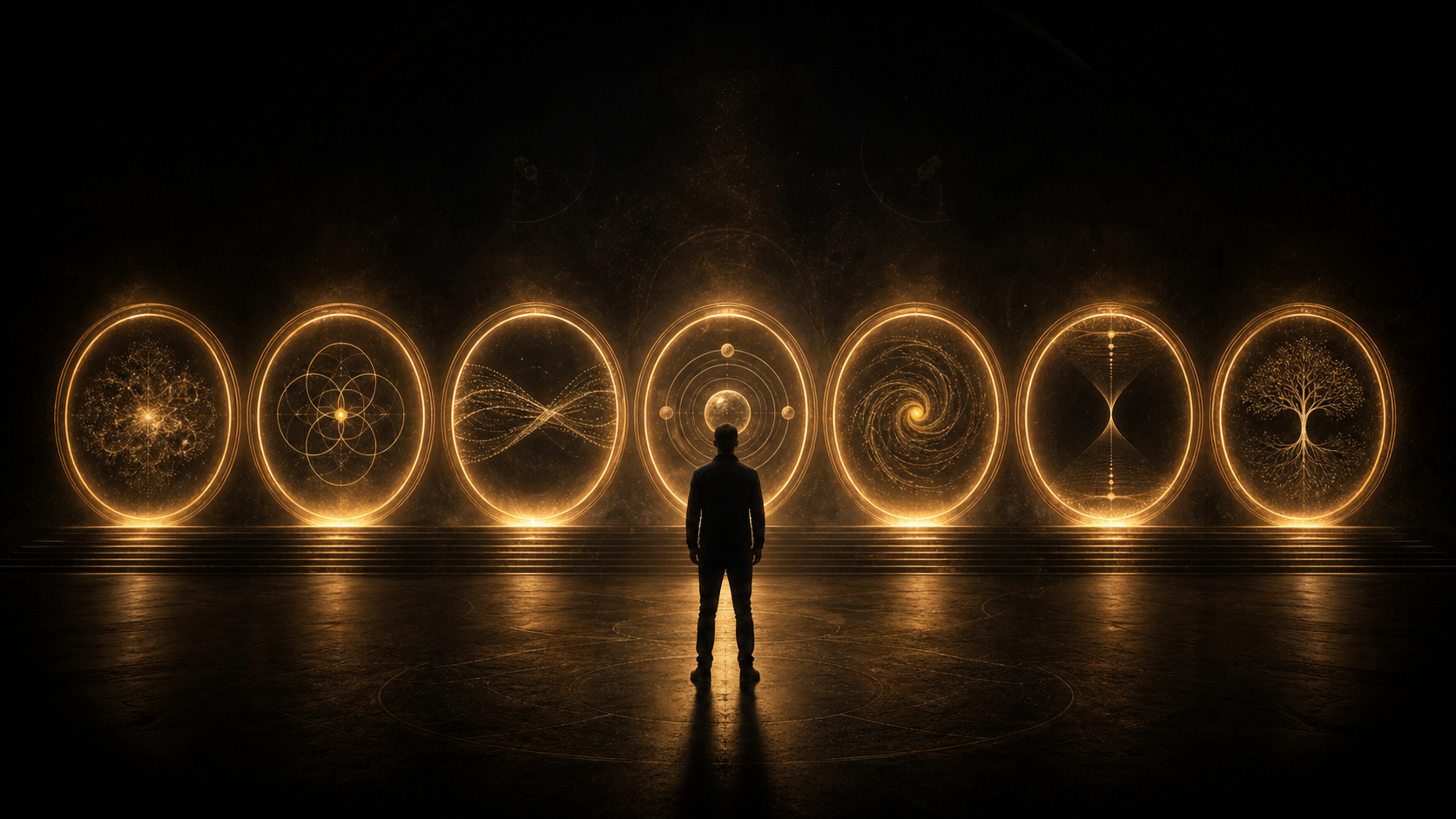
A deep guide to the seven Hermetic principles, the hidden laws of mind, pattern, rhythm, polarity, cause and effect, and the art of becoming conscious inside your own life.
Nobody teaches you how to read reality.
You are taught how to read language, clocks, numbers, instructions, contracts, and screens. You are taught how to behave in systems that already existed before you arrived. But almost nobody teaches you how to read the invisible laws moving underneath a life. The laws behind thought, pattern, reaction, timing, attraction, repetition, and consequence.
So people grow up intelligent and still feel governed by things they cannot name. They repeat the same relationship with different faces. They carry the same fear into new rooms. They change the outer scenery and somehow recreate the same inner climate. They call it luck, fate, personality, trauma, chemistry, timing, or coincidence.
Hermetic philosophy gives another possibility. Maybe life is not random. Maybe your patterns are not meaningless. Maybe reality has a grammar, and the suffering begins when you are living inside a language you were never taught to understand.
The modern list known as the seven Hermetic principles comes from The Kybalion, a 1908 text published under the name Three Initiates. It was inspired by the older Hermetic tradition, a body of philosophical, mystical, and symbolic writings associated with Hermes Trismegistus.
That distinction matters. The Kybalion is not the same thing as the ancient Corpus Hermeticum. It is a later interpretation, shaped by the spiritual language of its own time. But the reason it has endured is simple: the seven principles offer a practical map for self-awareness. They take ideas that can feel abstract and make them usable in daily life.
This article does not ask you to believe in them blindly. It asks you to read them as mirrors. Not as superstition, not as performance, not as spiritual decoration, but as a way of asking sharper questions about the mind, the body, the choices you repeat, and the reality you keep participating in.
The first Hermetic principle says that everything begins in mind. This does not mean the physical world is fake. It means your experience of the world is filtered through consciousness before it becomes a feeling, a choice, a memory, or a life direction.
Two people can enter the same room and meet two different realities. One sees danger. One sees possibility. One hears criticism. One hears information. One expects abandonment. One expects conversation. The room may be the same, but the mind has already colored the walls.
Mentalism is not shallow positive thinking. It is not pretending pain does not exist. It is the discipline of noticing the inner script before it becomes the outer pattern. The thought you repeat becomes the lens you trust. The lens you trust becomes the behavior you justify. The behavior you justify becomes the life you call normal.
If you want to change an experience, begin by asking what thought has been allowed to rule it. Not once. Repeatedly. Quietly. So often that it no longer feels like thought, but truth.
The second principle is often reduced to the phrase as above, so below. Its deeper meaning is that patterns repeat across levels. What appears in one part of life often reflects what is operating somewhere else.
A person who cannot hold boundaries in love may also struggle to hold boundaries at work. A home that is never allowed to rest may mirror a nervous system that is never allowed to soften. A repeated conflict with other people may reflect an unresolved conflict with the self.
This is where the Hermetic principles become deeply psychological. They teach you to become a reader of patterns, not only a reactor to events. If the same emotional architecture keeps appearing in your friendships, your body, your work, or your relationships, the question is not only what happened. The better question is what is corresponding.
Your outer life is not always your fault, but it is often your mirror. It shows you where energy is blocked, where truth has been postponed, and where the same lesson has learned to wear different clothes.
The third principle says that nothing rests. Everything moves. Everything carries a state. In physical terms, matter is never as still as it appears. In psychological terms, every room, relationship, thought, and body carries a tone.
You know this without needing anyone to prove it to you. Someone enters a room heavy with resentment, and the air changes. Someone speaks with grounded love, and the body listens before the mind has finished translating. Certain music reaches places language cannot reach. Certain people leave you exhausted without ever raising their voice.
Vibration is not an excuse to judge people as high or low. It is an invitation to become responsible for the state you are practicing. Anxiety has a rhythm. Envy has a texture. Integrity has a temperature. Shame has a posture. Love has a field.
To work with this principle, ask what you are rehearsing internally every day. A life is not only built by what you do. It is built by the state from which you do it.
The fourth principle says that everything has its opposite, and that opposites are often two ends of the same spectrum. Hot and cold are degrees of temperature. Courage and fear are degrees of relationship to danger. Love and indifference may be degrees of openness or closure.
This principle is powerful because it removes the fantasy that you must destroy what hurts you before you can become free. Often you do not destroy a state. You move along it. You move from fear toward courage, from resentment toward understanding, from collapse toward steadiness, from obsession toward devotion, from self-abandonment toward self-respect.
A person trapped in shame does not need to become a different species of human being. They need movement along the pole. One honest sentence. One boundary. One act of self-respect. One refusal to turn the old wound into a permanent identity.
This is why self-awareness is not passive. It is movement. It is the moment you stop worshipping the emotional weather and begin learning how to shift your position inside it.
The fifth principle says that everything moves in cycles. Expansion and contraction. Expression and silence. Effort and recovery. Birth, growth, decline, death, renewal. The tide does not apologize for leaving the shore. The season does not call itself a failure because it becomes winter.
Modern life has almost no respect for rhythm. It wants permanent productivity, permanent clarity, permanent beauty, permanent emotional availability, permanent youth, permanent output. Then the human body breaks under the violence of that demand and calls its natural cycles a problem.
Rhythm teaches timing. It teaches you not to confuse rest with laziness, slowness with failure, or a quiet season with abandonment by life. Some periods are for planting. Some are for harvesting. Some are for grieving the version of you that cannot continue. Some are for becoming strong in the dark.
If you understand rhythm, you stop panicking every time energy changes shape. You begin to ask whether life is ending or simply turning.
The sixth principle says that nothing happens without cause. This is not a cold statement. It is a liberating one, if you can bear its honesty.
A pattern is not random because it hurts. A reaction is not meaningless because it is inconvenient. A relationship dynamic does not become accidental just because it is familiar. Every effect has a cause somewhere, even if the cause is old, hidden, inherited, denied, or buried beneath years of survival.
This principle does not mean you caused everything that wounded you. That would be cruel and false. It means that once something has entered your life, your power begins in tracing the causes you can now work with. What belief keeps feeding this? What choice keeps repeating it? What environment keeps rewarding it? What wound keeps selecting it?
Cause and effect turns pain into inquiry. It asks you to stop staring only at the symptom and begin following the thread back to the origin. Not to blame yourself, but to recover your power from the place where it was first abandoned.
The seventh principle is often misunderstood because of the word gender. In Hermetic philosophy, this is not about biological sex or social identity. It is about two creative movements that exist inside all creation: the initiating principle and the receptive principle, the spark and the vessel, the seed and the soil.
A vision without structure remains fantasy. Structure without vision becomes a cage. Fire without ground burns itself out. Ground without fire never begins. Every book, relationship, healing process, business, art form, and new identity requires both movements.
Some people live addicted to beginnings. They love the rush of the idea, the first step, the announcement, the imagined future. But they resist the patience required to build. Others live imprisoned by preparation. They organize, analyze, wait, perfect, and protect themselves from the risk of beginning.
The principle of Gender asks for integration. Begin, then hold. Imagine, then form. Desire, then discipline. Receive, then act. Create, then sustain. The person who can carry both becomes difficult to manipulate, because they are no longer waiting for the outer world to provide the missing half of their own creative power.
The seven Hermetic laws do not remove difficulty. They remove a certain kind of blindness. They teach you to stop treating every experience as isolated and begin seeing the pattern underneath the event.
Mentalism asks what thought is building the room you keep entering. Correspondence asks where the same pattern is appearing on another level. Vibration asks what state you are practicing. Polarity asks where movement is possible. Rhythm asks what cycle you are inside. Cause and Effect asks what origin is asking to be seen. Gender asks whether your creation has both spark and structure.
This is not about becoming mystical in a theatrical way. It is about becoming precise. It is about learning how to read your inner life before it becomes your outer life. It is about seeing the mask, the wound, the rhythm, and the repeated choice with enough honesty that something finally has room to change.
Imagine learning at fifteen that your thoughts are not harmless background noise. Imagine learning at twelve that patterns repeat until they are understood. Imagine learning at seventeen that rest is not moral failure, that emotion has polarity, that relationships mirror inner agreements, and that freedom begins with tracing causes instead of drowning in effects.
This is the education many people never received. They learned how to pass exams, but not how to understand desire. They learned how to obey schedules, but not how to respect rhythm. They learned how to perform confidence, but not how to build inner authority. They learned how to survive the world, but not how to interpret the self.
The cost of that absence is everywhere. In burnout. In compulsive relationships. In identity confusion. In spiritual hunger. In the ache of people who are successful on paper and still privately feel like strangers to their own lives.
You do not need to master all seven Hermetic principles at once. Begin with the one that disturbs you a little. The one that feels uncomfortably accurate. The one that explains the pattern you have been circling for years.
If Mentalism finds you, listen to your dominant thought. If Correspondence finds you, study the pattern that appears everywhere. If Vibration finds you, become honest about the state you are carrying. If Polarity finds you, move one degree toward the opposite you desire. If Rhythm finds you, stop calling your season a failure. If Cause and Effect finds you, trace the root. If Gender finds you, ask whether your dream has both fire and form.
The purpose is not to become perfect. The purpose is to become conscious. That is the work of The Psyche Unveiled: to look beneath the surface of behavior and ask what law, wound, pattern, desire, or hidden intelligence is moving there.
The laws do not wait for belief. They are already moving through thought, choice, relationship, timing, and consequence. The only question is whether you will keep being shaped by them unconsciously, or whether you will begin to participate on purpose.
